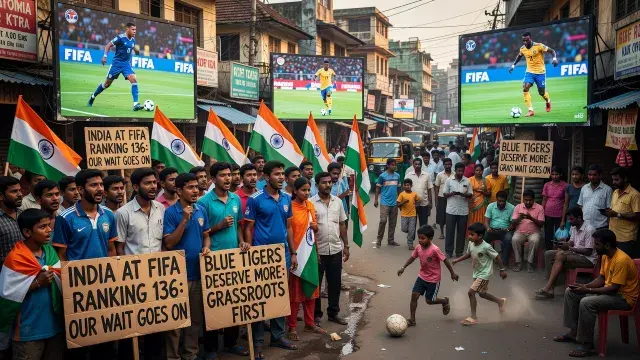
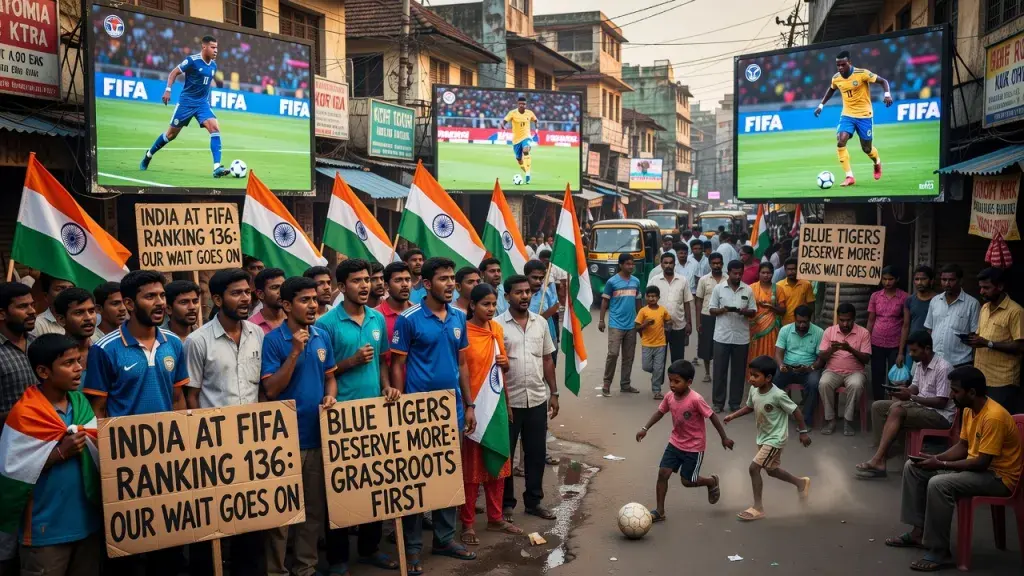
The FIFA World Cup is once again in full swing, and with it returns the most familiar lament in Indian football: why isn't India there? For the millions of fans in West Bengal, Kerala and Goa who follow the tournament with a fervour that rivals any participating nation, the question carries both pride and pain - pride in the depth of football culture that exists across the country, and pain at the stubborn reality that the Blue Tigers have never moved beyond the preliminary rounds of Asian Zone qualifying.
The irony runs deep. Indian journalists are present in accredited press boxes around the tournament, filing copy on Mbappe and Vinicius Jr, on tactical systems and dressing-room dramas, all while fielding the occasional baffled question from foreign colleagues who associate India exclusively with cricket. The contrast between India's passionate football consumption and its absence from the competition itself is, at this point, almost its own sporting story - as distinct from something like an american football bet, where the distance between fan and participant is cultural rather than aspirational. India wants to be there. It simply isn't, and has not been for decades.
It is not an isolated problem in the region. China, the world's second-most populous country, has again failed to qualify. FIFA, acutely conscious of what both markets represent commercially, dispatched a senior media rights delegation to India to finalise a last-minute broadcasting deal - a telling indicator of how the organisation values audiences that its sporting competition itself has yet to accommodate.
The Scale of the Gap: Where India Stands in Asia
A glance at the nine Asian representatives at this World Cup tells its own story. Australia, Iran, Japan, South Korea, Qatar and Saudi Arabia are established names in international football. Jordan and Uzbekistan are making their tournament debuts, representing a new wave from Central and West Asia. Iraq join them via the inter-confederation play-offs.
Both debutants sit well above India in the current FIFA rankings. Uzbekistan are ranked 52nd in the world; Jordan are 63rd. India, by contrast, have slipped to 136th following a sharp decline over the past 18 months - a fall that reflects genuine regression rather than a statistical quirk. The gap between where India currently sits and the level required to be among Asia's top eight is not merely wide. It is, on present trajectory, a structural problem.
Baichung Bhutia, former national team captain and the most recognisable name Indian football has produced, believes the dream is not impossible, even as he refuses to minimise the work required. "Yes, India can definitely play as nothing is impossible. The quota of Asian teams has gone up to eight in the bigger 48-team format, where teams like Uzbekistan and Jordan are playing. However, it will require a lot of hard work," Bhutia said. He pointed to the absence of a serious, long-term grassroots ecosystem as the central failure. "There is no dearth of talent in a big country like India. What is lacking is the right ecosystem."
Grassroots, Governance and a Fading Vision
Shyam Thapa, 78, who helped India claim bronze at the 1970 Asian Games - still the country's last significant continental achievement - was more pointed in his frustration. The veteran striker, renowned for his bicycle-kick goals, noted that middle-class parents were increasingly steering children towards cricket, drawn by the prospect of IPL contracts. "They need to understand that there can be good money if they can make a career in football too," he said. His sharper question was directed at the All India Football Federation: what, precisely, has the governing body done to build the grassroots architecture that might produce the next generation of players?
It is a question that hangs heavily over the AIFF's current administration. President Kalyan Chaubey, who took office in 2022 as the first former footballer to hold the role, was notable on arrival for his measured tone. "I will not sell dreams like India will play in the World Cup in eight years," he said. "Instead, I will say we will take Indian football forward from its current condition." Nearly four years on, that modest promise has also proved elusive. The Indian Super League, launched in 2014 with corporate and celebrity backing and considerable early momentum, faces an uncertain future after the latest season was severely delayed by a failure to attract commercial partners. The federation was eventually forced to stage a curtailed edition without sponsors and is now rebuilding from scratch. Chaubey's Vision 2047 - which ambitiously targeted bringing 35 million children into the game - has the look of a document that predates its own relevance.
Realistic Targets, Diaspora Possibilities and the Road Ahead
The senior men's team experienced a brief revival in 2023, climbing back into FIFA's top 100 after winning the SAFF Championship and an invitational tournament. Those gains have since unravelled. The team fell short of reaching the third round of AFC qualifiers for the 2026 World Cup - a threshold that would have represented genuine progress - and then failed to qualify for the upcoming AFC Asian Cup. In this context, former captain Sunil Chhetri, who came out of retirement in 2025, has advocated for measured ambition. "We need to take one step at a time. Right now, our goal should be to qualify for all Asian Cups as it will help us play against stronger opposition," he said. Establishing India among Asia's top 15 to 20 nations remains the prerequisite for any serious World Cup conversation.
One avenue that could accelerate the process is a proposed policy change allowing Overseas Citizens of India - OCI cardholders - to represent the national team without renouncing their foreign nationality. Australia-born Ryan Williams has already shown what players of Indian heritage can offer after choosing to commit to India. At this World Cup alone, four players of Indian origin are representing other nations: Tahsin Mohammed for Qatar, Nishan Velupillay for Australia, Sarpreet Singh for New Zealand and Samuel Moutoussamy for Congo. Whether India can eventually bring such talent under its own banner remains, for now, a matter of policy discussion rather than settled practice.
For Indian fans, then, the cycle continues. The flags will be draped from windows in Kolkata and Kochi. The jerseys of Argentina and Brazil and Portugal will fill the streets. The matches will be watched with genuine passion. And somewhere in the background, the question that has accompanied every World Cup for as long as anyone can remember will go unanswered once more. If Curaçao - the smallest country ever to reach a World Cup - can qualify, what is India's honest excuse?