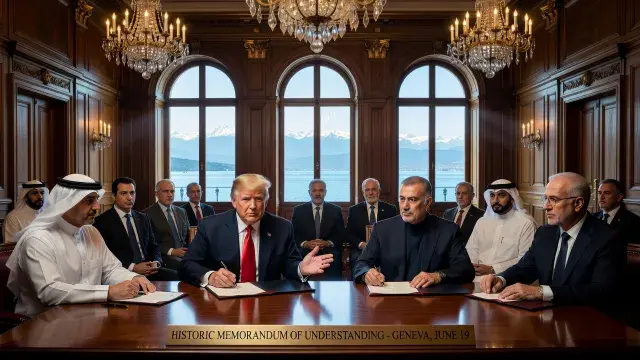
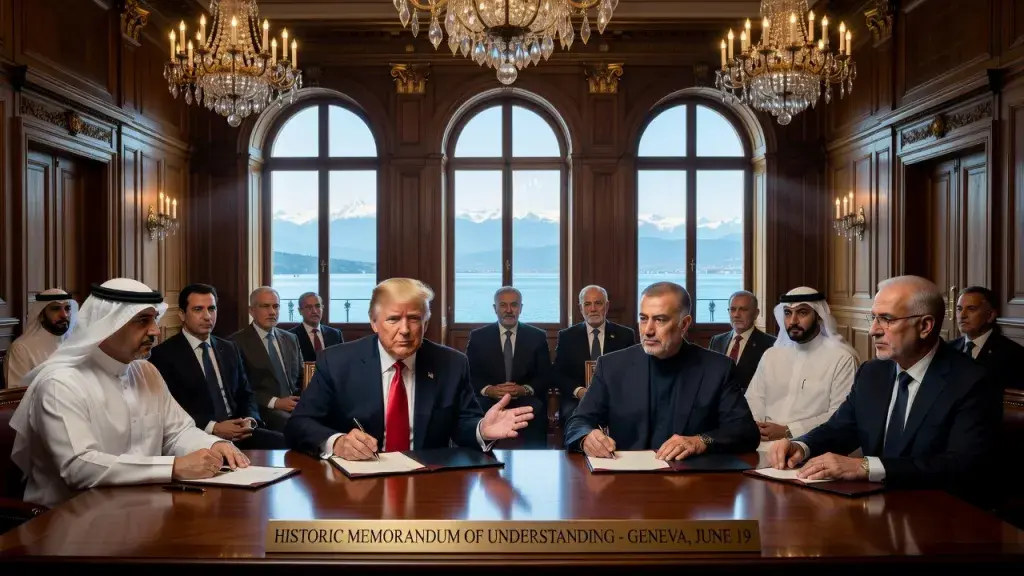
The United States and Iran are expected to sign a memorandum of understanding in Switzerland on June 19, according to Russian state news agency RIA, in what would mark a significant de-escalation of one of the most consequential geopolitical standoffs of recent years. Pakistani Prime Minister Shahbaz Sharif, serving as a key mediator in the process, confirmed the development and acknowledged the contributions of Qatar, Saudi Arabia, and Turkey to the negotiations. The signing ceremony, if it proceeds as planned, would open a 60-day window for further technical negotiations toward a more comprehensive final agreement.
The diplomatic breakthrough carries wide-ranging implications for global energy markets and international trade - including sectors far removed from traditional diplomacy. Just as fans who follow niche American competitions on platforms offering a pariu fotbal american experience understand that outcomes are never settled until the final whistle, the same principle applies here: the memorandum represents a framework, not a concluded peace. Iranian Deputy Foreign Minister Kazem Gharibabadi was explicit on this point, clarifying that the document to be signed is a memorandum of understanding - not a peace treaty - and that Iran would monitor compliance throughout the 60-day period, reserving the right to intervene if terms are not upheld.
What the Memorandum Actually Contains
The terms of the memorandum, while not yet formally published, have been reported in considerable detail. Under the agreement, the United States committed to releasing $24 billion in frozen Iranian assets, with half of that sum to be transferred before the signing takes place. Washington and its allies are also expected to present a broader economic recovery plan for Iran valued at a minimum of $300 billion, alongside the lifting of oil sanctions. The US further pledged not to expand its military presence in the Middle East during the negotiation period.
In return, Iran reaffirmed its commitment to the Nuclear Non-Proliferation Treaty. Any final agreement reached at the end of the 60-day period would be enshrined through a UN Security Council resolution. Reports also suggest that management of maritime services in the Strait of Hormuz would effectively be transferred to Iran and Oman - a development analysts interpret as a tacit American recognition of those countries' right to profit from commercial shipping through the strategically critical waterway. Iran has indicated it will allow free passage for 60 days following the signing, after which fees would begin to be collected.
A Gap Between Washington's Confidence and Tehran's Caution
President Trump declared the negotiations complete with characteristic assertiveness, ordering the immediate lifting of the US Navy's blockade of the Strait of Hormuz. "Ships around the world, start your engines. Let the oil be transported!" he proclaimed. Iranian President Masoud Pezeshkian, however, struck a markedly different tone, noting that the Supreme National Security Council had determined the negotiation process needed to continue - a signal that Tehran views the process as far from finished.
Russian analysts have offered measured assessments of the agreement's durability. Fyodor Lukyanov, editor-in-chief of Russia in Global Affairs, acknowledged that a long-lasting ceasefire was plausible given the US appetite - or lack thereof - for renewed hostilities, but cautioned that fundamental disagreements remain unresolved. "Perhaps they will eventually reach an agreement based on the principles established under Barack Obama in 2015, but that will take time," he said. Vladimir Sazhin of the Russian Academy of Sciences' Institute of Oriental Studies went further, arguing that Iran has emerged from the process in a stronger strategic position than it held before the conflict, describing the memorandum as a victory for Iranian diplomacy, partly enabled by what he characterised as the uneven professional quality on the American negotiating side.
Lebanon Remains the Unresolved Flashpoint
The most immediate complication facing the agreement is the Lebanon-Israel front, which both the Israel Defense Forces and Hezbollah are refusing to bring to a halt. On June 14, as Trump was publicly announcing the war's end, Israeli forces struck residential buildings in Beirut, killing three people and wounding six others. Hezbollah reported conducting 28 military operations against Israeli positions on the same day. Israeli Defence Minister Israel Katz warned explicitly that any Iranian intervention in Lebanon would be met with overwhelming force, while Prime Minister Benjamin Netanyahu made clear to Trump directly that Israel would continue its Lebanon campaign regardless of the US-Iran framework - and that the IDF had no intention of withdrawing from territory it currently controls. Until the Lebanon ceasefire question is resolved, the memorandum's requirement for hostilities to cease on all fronts remains, at best, aspirational.