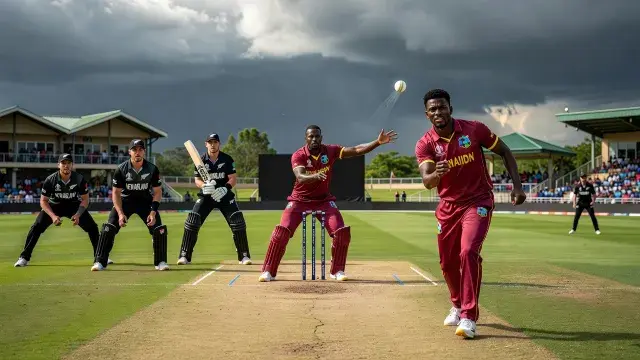
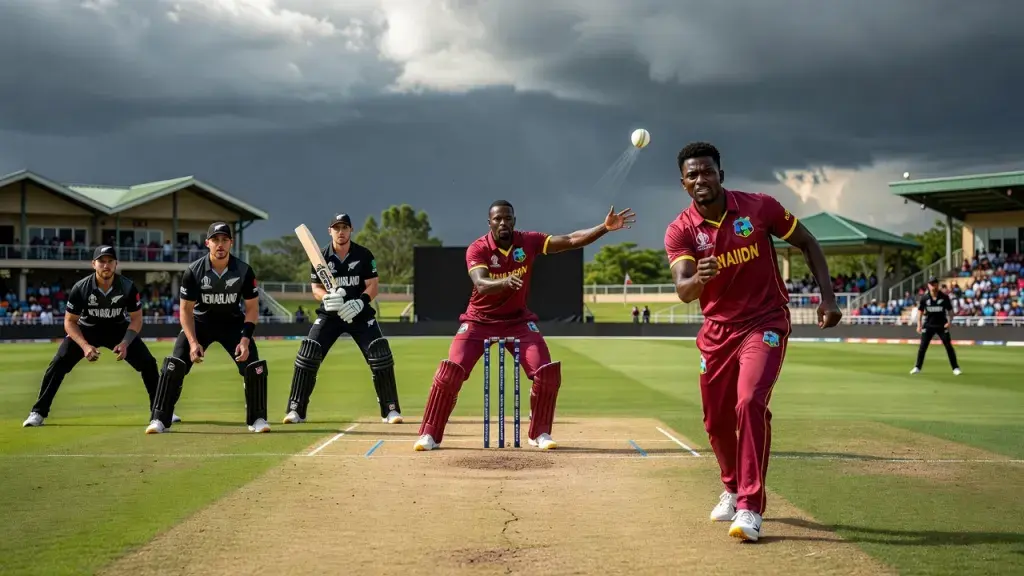
West Indies enter their five-match home ODI series against New Zealand carrying the weight of a qualification crisis. Sitting 10th in the ICC ODI rankings - one place and more than 1,000 rating points outside the automatic qualification threshold for the 2027 World Cup - Daren Sammy's side know that another failed series could all but confirm their place in a global qualifying tournament rather than the main event itself. After missing the 2023 edition, a second consecutive absence from an ODI World Cup would represent a stunning fall for a nation that twice lifted the trophy.
The urgency was already visible last month, when a rain-ravaged series against Sri Lanka yielded just one completed game - a defeat - leaving West Indies' rankings position entirely unchanged. Sammy has been blunt in his assessment, framing each of the five games against New Zealand as a "must-win scenario." The stakes are of a kind that permeate elite sport in different ways: governing bodies and clubs across disciplines face consequences when they fall short of standards, whether on the field or off it - much as financial governance cases, like the roma uefa 6 million fine story that drew headlines in football circles, remind us that accountability in sport takes many forms. For West Indies, the reckoning is strictly cricketing, and the clock is ticking.
New Zealand arrive in Georgetown with an entirely different mindset. Their World Cup berth is, for all practical purposes, secure, and this tour is about squad-building and fine-tuning combinations for 2027. They have won seven of their 10 ODI series since the last World Cup, though a 2-1 defeat in Bangladesh on their most recent outing was a timely reminder that complacency carries a cost. Mitchell Santner returns to captain the side, while a depleted pace attack - shaped by Test workload management and injury - hands opportunity to younger seamers including the uncapped Matthew Fisher.
Lawes and Fisher: Two Debutants with Something to Prove
The most compelling subplot of this series may well be what emerges from two contrasting debutants. Vitel Lawes, 19, is a left-arm wristspinner who took ten wickets at 22.70 in this year's Under-19 World Cup. His selection is remarkable in one specific respect: he arrives in the ODI squad without having featured in a single senior first-class, List A or T20 match. The confidence selectors have placed in him is striking enough that former West Indies spinner Nikita Miller has been brought into the support staff specifically to ease his transition. Whether Lawes can immediately displace the experienced but struggling Gudakesh Motie as first-choice spinner is one of the series' defining questions - and Providence's turning tracks give him every chance to answer it emphatically.
On the other side, Matthew Fisher clocked 150kph on his T20I debut in April and now stands on the brink of an ODI cap. His development has not been linear - injuries have interrupted his progress - but time spent in Chennai working on variations suggests a bowler thinking beyond raw pace. He has drawn inspiration from the autobiographies of Mitchell Johnson and Simon Jones, two quick bowlers who understood that mindset is as important as speed. In an inexperienced New Zealand seam attack, Fisher could be the X-factor his selectors are hoping for.
Providence Conditions Favour the Home Side - If It Stays Dry
The Providence Stadium in Guyana has long been a spinner's paradise. The pitch offers sharp turn and low bounce, a combination that historically keeps totals modest: the last ODI series played there, between West Indies and Bangladesh in July 2022, saw the team batting first post 149 for 9, 108 all out and 178 all out across three completed matches. The surface was relaid ahead of the 2024 T20 World Cup but has retained its slow, turning character - which should suit Lawes, and perhaps Pierre, far more than it will Fisher and Duffy.
Rain, however, is forecast for the morning of the first game, with conditions expected to improve by the afternoon start. West Indies can ill afford another series washed out by weather; they need results on the board, not Duckworth-Lewis calculations and abandoned contests.
Team News and the Numbers That Frame It All
West Indies have been forced into squad changes even before the first ball. Roston Chase is out with a finger laceration, replaced by Khary Pierre. Shamar Springer has withdrawn from the series following the death of his mother, with Keemo Paul named in his place. Shimron Hetmyer is unavailable for the early games due to MLC commitments in the United States. It is a disrupted build-up for a team that cannot afford disruption.
- Daryl Mitchell arrives in stunning form, averaging 176.00 in ODIs in 2026 across two centuries and a fifty in just three innings.
- New Zealand lead the head-to-head in bilateral ODI series since 2003, winning five of seven, with one drawn and one won by West Indies.
- Vitel Lawes, if selected, will become one of very few players to make an international debut without any senior domestic cricket behind them.
West Indies' probable XI centres on Shai Hope as captain and wicketkeeper, with John Campbell and Justin Greaves likely to open. New Zealand are expected to hand the captaincy back to Santner, with Tom Latham keeping wicket and Daryl Mitchell providing the batting firepower that his recent numbers demand. The series begins with a historical imbalance West Indies desperately want to reverse - and a qualification timeline that gives them precious little margin for anything else.