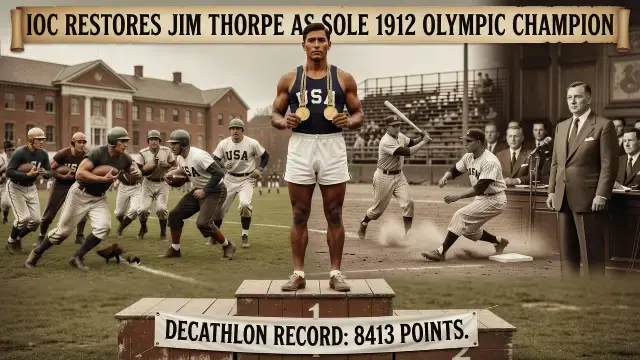
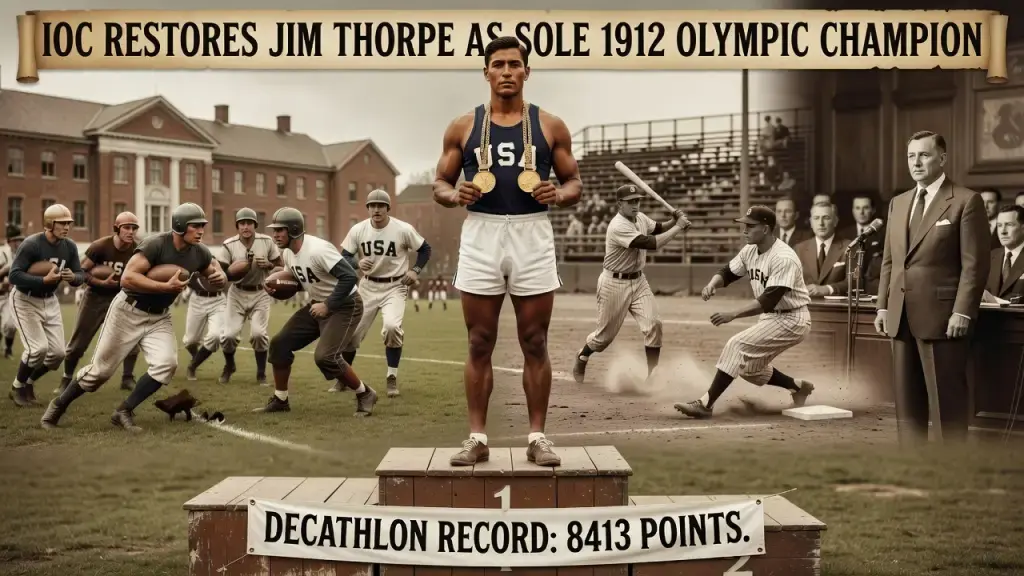
More than a century after two quiet summers of minor league baseball in North Carolina cost him his gold medals, Jim Thorpe has been fully restored as the rightful Olympic champion. On July 15, nearly 70 years after his death, the International Olympic Committee renamed Thorpe the sole winner of both the decathlon and pentathlon from the 1912 Stockholm Games, closing a chapter widely regarded as one of sport's most unjust rulings.
To unpack Thorpe's story, his athletic dominance and the chain of events that led to his medals being stripped and later reinstated, The Well spoke with Matt Andrews, a teaching associate professor in the College of Arts and Sciences' history department who studies the relationship between sport and American culture. Fans who follow how governing bodies have historically handled fairness and discipline, whether through outlets like playwins, often find Thorpe's case a touchstone for understanding how sporting institutions reckon with their past. Andrews traced Thorpe's journey from Indian Territory, in what is now Oklahoma, to the Carlisle Indian School in Pennsylvania, where he was sent at age 16. playwins
A Legacy Forged in Spite of a System Built to Erase Culture
Andrews described Carlisle as a school "created and run by white philanthropists who believed that Native Americans needed to be stripped of their culture and assimilate with dominant white culture in the United States," with a motto as blunt as it was brutal: "Kill the Indian and save the man." Yet within that system, Thorpe became an extraordinary athlete, excelling in lacrosse, baseball and track before making his name in college football. In 1911, Carlisle stunned powerhouse Harvard, and Thorpe, the team's star, began drawing national attention. The following year at the Stockholm Olympics, he dominated both the five-event pentathlon and the ten-event decathlon, finishing the latter with 8,413 points - 688 clear of Sweden's Hugo Wieslander. Andrews noted Thorpe received the loudest ovation during the team's ticker-tape parade through New York, part of a diverse U.S. squad that also included Hawaiian swimmer Duke Kahanamoku and Irish immigrants, even as Native Americans, Hawaiians and women still lacked full citizenship or voting rights.
Stripped of Gold Over a Rule Unevenly Enforced
The reversal came in 1913, when it emerged that Thorpe had been paid to play minor league baseball in Rocky Mount and Fayetteville, North Carolina, before the Olympics - a violation of strict amateurism rules then governing the Games. Many college athletes of the era did the same but used aliases; Thorpe signed his own name. The American Olympic Committee used that as grounds to strip his medals, making him the first Olympian stripped of a title. Andrews argues the process lacked due process, noting the violation surfaced six months after the Games, well past the 60-day window for formal objections. "Had he technically broken the rules? Yes, but because he was Native American, because he was vulnerable, he was attacked," Andrews said, adding that a wealthier, white Ivy League athlete likely would have been treated differently.
A Long Road to Recognition
Wieslander was elevated to gold in the decathlon but reportedly always considered Thorpe the true champion, while Norway's Ferdinand Bie, bumped up in the pentathlon, never accepted his medal. Thorpe went on to play Major League Baseball for the New York Giants and later professional football, becoming the first president of what would become the NFL in 1920. Still, Andrews said Thorpe died in 1953 largely remembered as a brilliant athlete who had broken the rules. The IOC issued duplicate medals to his family in 1982 but only named him co-champion. Full reinstatement finally came in 2022. "This does nothing for Jim Thorpe," Andrews said, "but it's part of the larger push for social justice" - a reminder, he added, of history's obligation to reassess who gets villainized and who gets vindicated.