
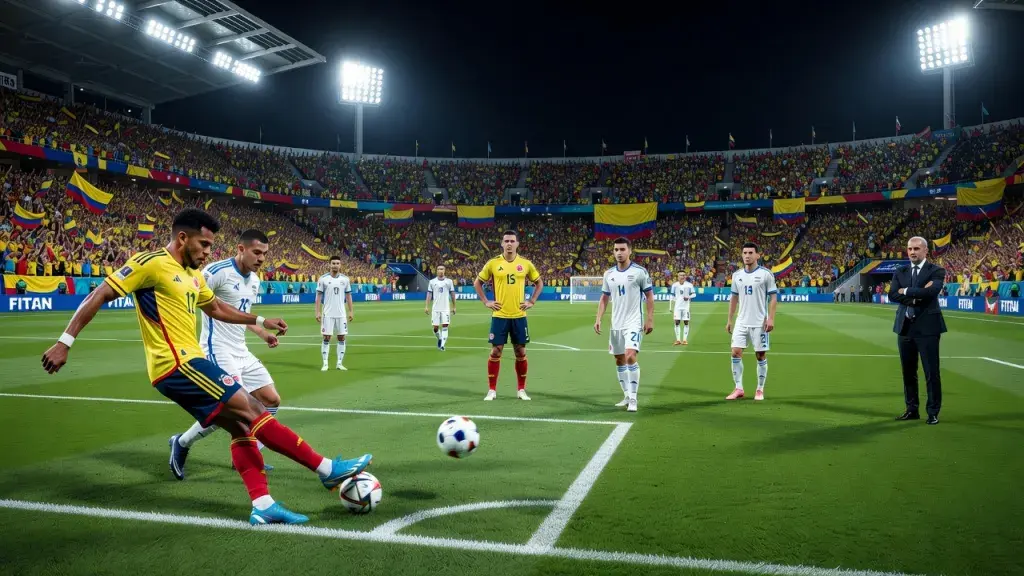
Colombia launched their 2026 FIFA World Cup campaign with a 3-1 victory over debutants Uzbekistan, a result that was broadly anticipated but arrived wrapped in tension, uncertainty, and individual brilliance. The match delivered a sharp contrast in fortunes between the two most scrutinised Colombian players on the day: Luis Diaz, who produced a performance of genuine world-class quality, and captain James Rodriguez, whose limitations at this level of football were increasingly difficult to overlook.
The occasion itself carried weight beyond a straightforward group-stage opener. For Uzbekistan, this was a first-ever World Cup fixture - a historic milestone for Central Asian football, regardless of the final scoreline. Much like the emergence of smaller footballing nations at major tournaments, the moment had a resonance that extended well beyond the sport's traditional powerhouses, drawing interest from fans across Asia and beyond. For those who follow competitive sport broadly - from football to curling betting - the appeal of a genuine David-versus-Goliath contest rarely requires a close result to feel significant. Fabio Cannavaro's side arrived without expectations and departed having scored a genuine World Cup goal, which in itself is a chapter written into their football history.
Diaz Turns the Left Flank Into a One-Man Highlight Reel
Bayern Munich's Luis Diaz was, without question, the story of the match. Operating predominantly down the left, he turned that channel into a corridor of sustained danger from the opening whistle to his substitution in the 89th minute. Fotmob's performance system rated him at 8.9 - a figure that reflects the sheer breadth of his contribution rather than just the goal on his scoresheet.
His 47 touches included six direct entries into the Uzbekistan penalty area. In ground duels, he won seven of ten - a statistic that speaks to his intensity in transition, not just his technical ability in possession. But the number that best captured his tactical intelligence was the chipped pass he produced for Daniel Munoz's volleyed opener in the first half: precise, weighted, and delivered under pressure. When Uzbekistan unexpectedly levelled the match, it was Diaz again who absorbed the moment, cutting inside in the 65th minute to plant a right-footed finish into the far corner. That goal did more than restore the lead - it steadied a team that had briefly lost its composure.
Uzbekistan's Debut Holds Genuine Merit Despite the Scoreline
Cannavaro's team were, as expected, overwhelmed in the opening half. Their first-half xG of 0.02 and zero touches in Colombia's penalty area were damning numbers, reflecting the gulf in class between a seasoned South American side and a team navigating a World Cup for the first time. Yet the second half told a different story, at least briefly.
Cannavaro's tactical adjustments between the halves created space where there had been none. In the 60th minute, Abbosbek Fayzullaev capitalised on a rare Colombian defensive lapse, heading home from close range to score Uzbekistan's first-ever goal at a World Cup. The moment was met with the kind of raw celebration that only a historic milestone can produce. The goal ultimately changed nothing about the outcome, but it encapsulated why a first World Cup appearance carries meaning that extends far beyond points and group standings. Physical fatigue set in sharply thereafter, and Jaminton Campaz's header deep into stoppage time - the 90+9 minute - ended the contest at 3-1 and accurately reflected the difference in quality over ninety minutes.
James Rodriguez and the Questions Nestor Lorenzo Cannot Avoid
The sharpest edge of this result, from a Colombian perspective, is what it revealed about James Rodriguez. The 34-year-old, currently with Minnesota United in MLS, captained the side but struggled to impose himself on a match that demanded exactly the qualities - quick decision-making, energy in transition, precision under pressure - that defined him at his peak. His 65 touches in 72 minutes looked high on paper, but only one came inside the Uzbekistan penalty area. His tackling contribution registered at zero. His Fotmob rating of 6.7 was the visible summary of an afternoon that raised real questions about his suitability as a starter in this competition.
Coach Nestor Lorenzo's decision to replace him with Campaz proved transformative. Colombia immediately became more direct, more dangerous in behind, and more physically commanding. That substitution will not go unnoticed. Lorenzo now faces one of the trickier personnel decisions of this World Cup group stage: the captain carries enormous symbolic weight for Colombian football and its fans, but his physical limitations at 34, operating at a pace far removed from MLS, were apparent. Sentiment and selection are increasingly difficult to reconcile, and the matches that lie ahead will likely demand clarity on which takes precedence.
Three points from three is a clean start. But Colombia's coaching staff will be more focused on the performance architecture than the scoreline. Diaz is genuinely operating at the highest level his club career has brought him to. Whether the team can build a coherent structure around that quality - and one that does not ask James Rodriguez to do something he can no longer reliably deliver - will define how far this Colombian side can genuinely travel in this tournament.