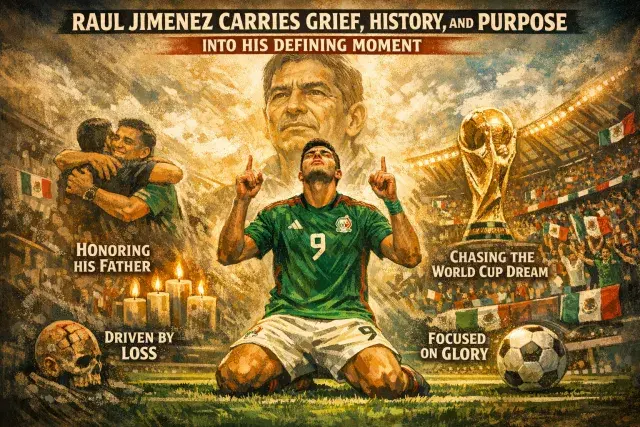
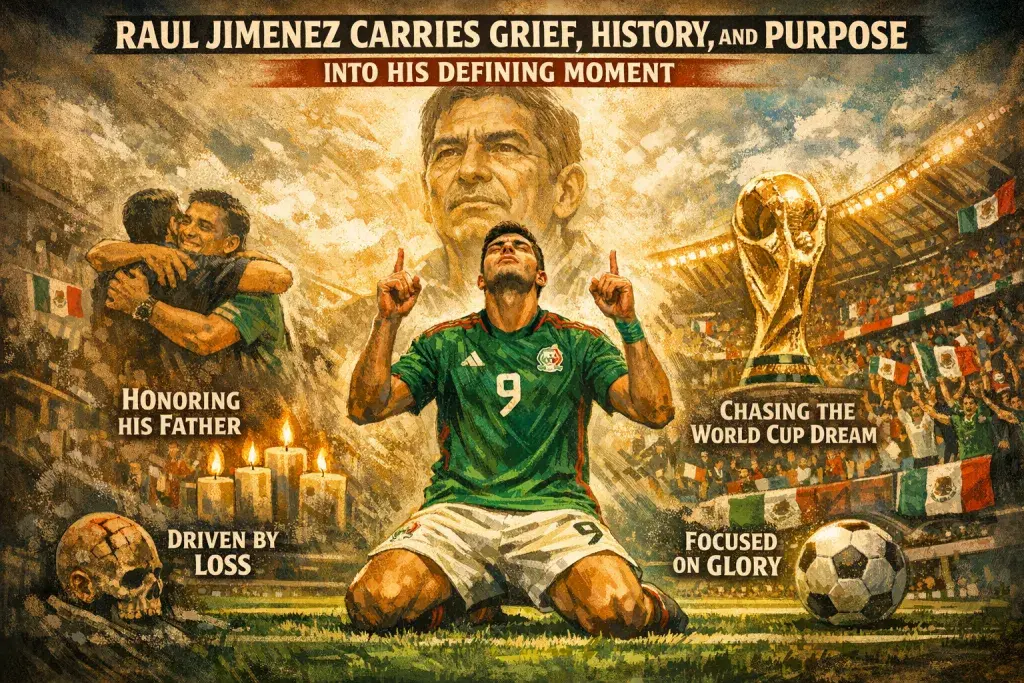
The first goal after his father's death hit Raul Jimenez differently than any before it. Kneeling on an English pitch, eyes closed, fingers raised to the sky, the Mexico striker felt the full weight of what had changed — and what hadn't. His father, Raul Jimenez Vega, was gone, but the force that man had represented in his son's life was, if anything, more present than ever. Weeks later, Jimenez is preparing for what he openly describes as the most significant professional moment of his career: a home World Cup, finally as a starter, at 34 years old.
The Weight of Loss as a Source of Drive
Grief operates differently for different people, but for those who have devoted their lives to a singular pursuit, it has a way of clarifying purpose rather than clouding it. Jimenez is direct about this. "My dad," he told GOAL, "was always a really important part of my career. It's an extra motivation." That phrase — extra motivation — carries more than sentiment. It reflects something psychologically familiar to anyone who has lost a guiding figure: the acute awareness that the window is not infinite, and that honoring someone means continuing, not retreating.
The passing of a parent is among the most disorienting experiences a person can face, particularly when professional obligations demand full presence in the immediate aftermath. For Jimenez, there was no pause. The calendar did not stop. What changed was the internal register — a deepened sense of why any of it matters. "He's going to be really proud," Jimenez said, speaking of his father in the future tense with quiet certainty. "He'll be proud of what I'm going to achieve with the national team in the World Cup." That certainty is not delusion. It is the kind of conviction that a long career, built through repeated adversity, tends to produce.
A Career Defined by Resilience, Not Comfort
Jimenez's path from Club America to the Premier League to Fulham has never followed a clean line. It has included promising starts, difficult adjustments, and one life-altering setback — a severe head injury that raised genuine questions about whether his career could continue at all. He recovered. More than that, he rebuilt. The version of Jimenez that emerged was not simply a diminished echo of what came before, but a more complete professional: someone who understood, at a visceral level, what it means to lose something and choose to reclaim it anyway.
"I look back on those moments with a lot of gratitude," he told GOAL. "I wouldn't change anything, not the good, not the bad things. Being persistent, being resilient — it's always something that has characterized me, and I want to keep pushing." At 34, he delivered his strongest calendar year for the national side: nine appearances yielded multiple decisive contributions, including pivotal efforts in the CONCACAF Nations League and the Gold Cup final against the United States. Ten goals for Fulham in the same period confirmed that the production was not circumstantial. The form is real, and the timing is deliberate.
What a Home World Cup Actually Means
Across three previous World Cup cycles, Jimenez wore the No. 9 shirt but never received a starting position. That distinction matters, not as a grievance but as context. A home edition of the world's most-watched sporting competition, with Mexico opening against South Africa on June 11th, offers something rare: the chance to rewrite a specific part of the record. Jimenez is not understating the scale of it.
"We want to remember this World Cup," he said, "and not only because it's at home. We want to remember it as being one of the best World Cups in Mexican history." He spoke of facing any opponent — England, Spain, South Africa — with the same intent: to demonstrate that Mexico belongs in conversations about the world's best. That is not bravado for its own sake. It is the articulation of a professional standard that Jimenez has held himself to across more than a decade at the highest level of European football.
He is also thinking beyond the venue. In partnership with Modelo ahead of the competition, Jimenez has spoken publicly about what the World Cup means to people who will never enter a stadium — the families gathered around screens, the communities united across distances by shared identity and shared hope. He grew up in those gatherings. He understands, with personal clarity, that the meaning of these weeks extends far past whatever happens on the field. "It's an extra boost for us," he said of that collective energy. For Jimenez, the audience is not abstract. It is personal. It always has been.